
It is a phenomenon observed by art educators, psychologists, and concerned parents alike: the sudden, heartbreaking silence that falls over a child’s creative output. For years, a child may have been a prolific producer of scribbles, confident stick figures, and fantastical, non-representational worlds. They drew with abandon, unconcerned with perspective or anatomy. But then, typically around the age of nine or ten – though increasingly earlier – a shift occurs. The child pushes away the blank paper. They cross their arms. They utter the sentence that marks the end of their uninhibited artistic era: “I can’t draw.”
This moment is often referred to as the “crisis of confidence” or the “artistic crisis”. It is not merely a loss of interest; it is a developmental milestone where critical perception outpaces technical skill. Children begin to see the world with increasing visual realism, yet their fine motor skills and understanding of technique lag behind. They look at their drawing of a horse, then at a photo of a horse, and the discrepancy is painful. The blank white page, once a playground of infinite possibility, transforms into a daunting void of potential failure.
At YoloColoring, we believe the solution to this creative block lies not in forcing the child back to the blank page, but in meeting them halfway. By utilizing printable coloring sheets as a “scaffold” – a supportive structure that reduces the cognitive load of composition and proportion – we can reignite the artistic spark. This report presents a comprehensive, research-backed methodology for using coloring pages not just as a passive activity for staying inside the lines, but as a dynamic launchpad for doodling, extending, and creating. We will explore how to transform the “empty spaces” of a coloring page into safe harbors for experimentation, allowing children to build the confidence required to eventually face the blank page again.
The Psychology of Artistic Inhibition
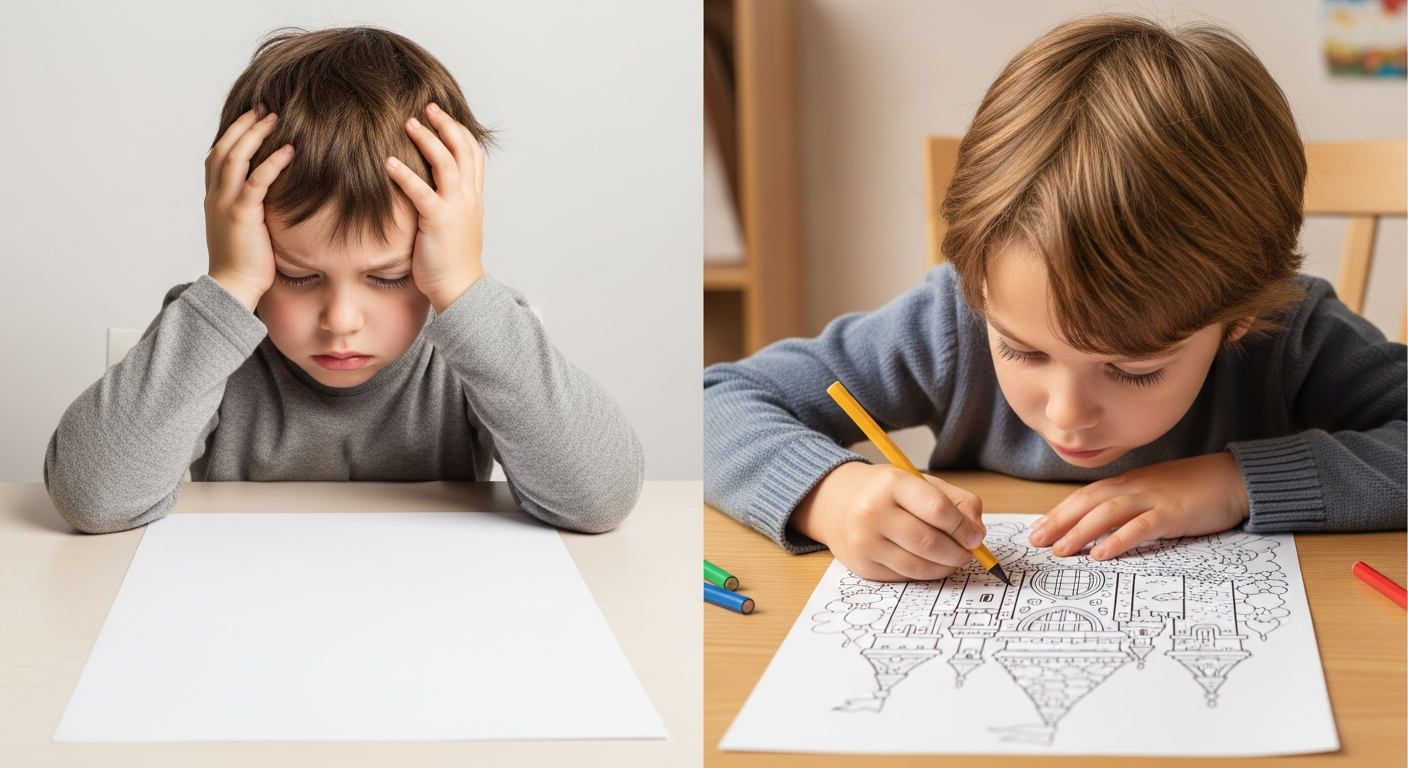
Comparison of a child feeling overwhelmed by a blank paper versus enjoying a coloring sheet.
To effectively intervene when a child claims they cannot draw, we must first understand the psychological mechanisms driving this inhibition. It is rarely a lack of talent, but rather a shift in cognition and social awareness.
The Developmental Shift: From Symbolism to Realism
In early childhood, drawing is a symbolic language. A circle represents a head; four lines represent limbs. This is the “schematic stage,” where children draw what they know, not necessarily what they see. They are telling stories, not capturing optical reality. However, as they approach the “dawning realism” stage (typically ages 9-11), their criteria for success changes drastically. They begin to value photographic accuracy.
The “crisis” manifests when a child’s critical eye develops faster than their hand’s ability to execute. They can see that a hand has five fingers and joints, but they can only draw a mitten-like shape. This gap creates frustration. As noted by Professor Ingeborg Stana, this critical voice says the drawing is “not realistic enough,” leading many children to abandon the practice entirely to avoid the feeling of incompetence.
The Paralysis of the Blank Slate
For a child struggling with perfectionism or low confidence, a blank piece of paper represents a high-stakes environment. It demands hundreds of simultaneous micro-decisions: What is the subject? How big should it be? Where does it go on the page? What is the background? If the very first line feels “wrong,” the entire project is deemed a failure. This decision fatigue can be paralyzing.
This is where the concept of scaffolding becomes vital. In education, scaffolding refers to providing temporary support to help a learner achieve a task they cannot yet do independently. Coloring pages act as this scaffold. They solve the hardest problems of drawing – proportion, composition, and subject matter – allowing the child to focus on specific, manageable creative tasks, such as texture, color choice, and background details.
The Neuroscience of Coloring and Creativity
Engaging with coloring pages does more than just fill time; it alters brain state. Research indicates that coloring activates both the left hemisphere (logic, focusing on lines and structure) and the right hemisphere (creativity, color mixing). This bilateral stimulation can induce a “flow state” – a psychological state of deep immersion where time seems to vanish and the “inner critic” is silenced.
By guiding a child into this flow state using a coloring page, we lower the cortisol levels associated with stress and anxiety. Once the amygdala (the brain’s fear center) is calmed, the child becomes more open to risk-taking. It is in this relaxed state that we can introduce the concept of “doodling in the gaps” – adding their own marks to the page. Because the “main event” (the printed image) is already perfect, the risk of “ruining” the drawing feels significantly lower. The coloring page provides a safety net, making the leap to drawing feel like a small step rather than a terrifying jump.
The “Doodle-in-the-Gap” Strategy
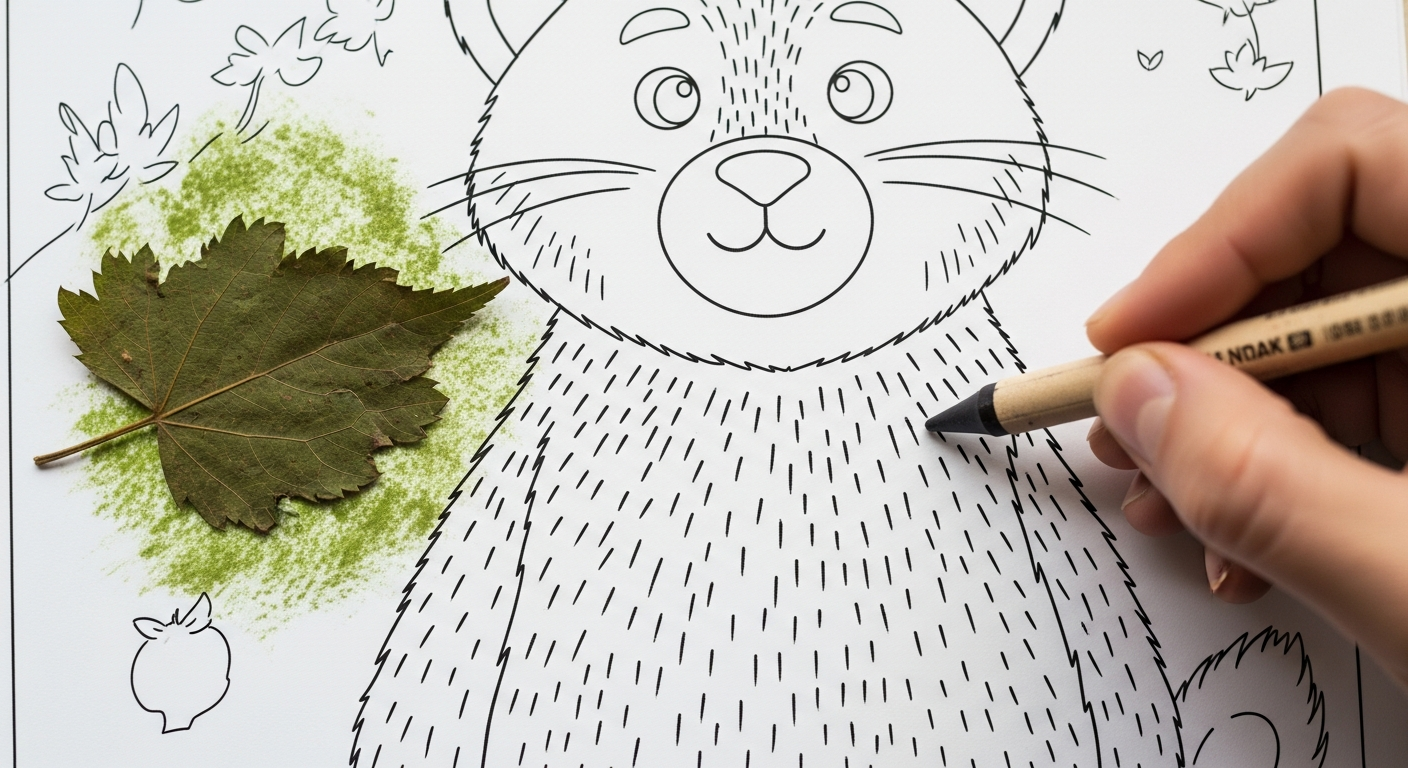
Close-up of a coloring page showing doodle techniques like texture rubbings and horizon lines.
The core intervention proposed in this report is the “Doodle-in-the-Gap” strategy. This method reframes printable coloring sheets from finished products that merely need color into “unfinished” collaborations that require the child’s artistic input to be complete. We move the child from being a passive consumer of art to an active co-creator.
Defining the Creative Zones
On any standard coloring page, there are three distinct zones ripe for intervention:
- The Background Void: The large white space surrounding the main subject.
- The Interior Space: The open areas within the subject (e.g., a dinosaur’s empty back, a girl’s plain dress).
- The Narrative Gap: The missing context (e.g., “Why is the character holding an umbrella?”).
By targeting these zones with specific, low-pressure prompts, we can scaffold the drawing skills of texture, perspective, and composition.
| Creative Zone | Typical Challenge | Scaffolding Solution | Target Skill |
| Background Void | “I don’t know what to draw behind him.” | Texture rubbings, horizon lines, gradients. | Composition, Perspective |
| Interior Space | “I can’t draw scales/fur.” | Repetitive pattern doodling (Zentangle). | Fine Motor Control, Texture |
| Narrative Gap | “I can’t draw a whole scene.” | “Finish the drawing” prompts (add one object). | Storytelling, Logic |
Phase 1: Conquering the Background
The easiest entry point for a hesitant artist is the background. It is less “precious” than the main character, so mistakes feel less critical.
Technique A: The Horizon Line Anchor
A floating figure contributes to the feeling of “unrealism” that bothers older children. The simplest drawing lesson is to add a horizon line.
- Instruction: Ask the child to draw a horizontal line behind the character’s feet.
- Result: The figure is instantly grounded. The page is now divided into “ground” and “sky.”
- Extension: This single line invites further questions. “If this is the ground, is it grass? Sand? Carpet?” If it is grass, the child only needs to draw short vertical dashes (a very low-skill, high-reward doodle) to create a texture.
Technique B: Texture Rubbings
For children who are convinced they cannot draw patterns, texture rubbings serve as a “magic trick” that builds confidence.
- Method: Place a textured object (a leaf, a coin, a piece of Lego baseplate, sandpaper) underneath the blank background area of the coloring page.
- Action: Have the child rub a crayon or soft pencil over the paper.
- Insight: This technique allows the child to “create” a complex background (like a brick wall or a forest floor) without needing the fine motor skills to draw every line. It teaches them to see texture as a component of art and fills the intimidating white space quickly.
Phase 2: The “Detail Doctor” (Interior Doodling)
Once the background feels managed, we turn to the subject itself. Many coloring pages feature broad, empty outlines. A “plain” coloring of a bear results in a flat, brown shape. We can encourage the child to become the “Detail Doctor.”
Technique A: Fur, Feathers, and Scales
Instead of coloring with a solid block of wax, encourage the child to use line making to fill the space.
- The Prompt: “Is this bear fuzzy? How can we show that he is soft?”
- The Action: Demonstrate drawing short, repetitive tick-marks to simulate fur.
- Skill Building: This repetitive motion helps develop the tripod grip and fine motor control required for handwriting, without the pressure of forming letters. The rhythm of making hundreds of small marks is also soothing and meditative, reinforcing the flow state.
Technique B: The Fashion Designer
Use coloring pages of people with plain clothing. This is a “safe” space for doodling because clothing patterns can be abstract.
- The Prompt: “This shirt is boring. Can you design a pattern for it? Maybe stripes, polka dots, or stars?”
- Why It Works: There is no “wrong” way to draw a pattern. A wobbly stripe is still a stripe. This guarantees success and allows the child to practice controlling their drawing tool within a defined boundary.
Phase 3: Extending the Narrative
This is the most advanced step, where the child adds new distinct objects to the scene. This bridges the gap between “coloring” and “drawing from scratch.”
Technique A: “What’s Missing?”
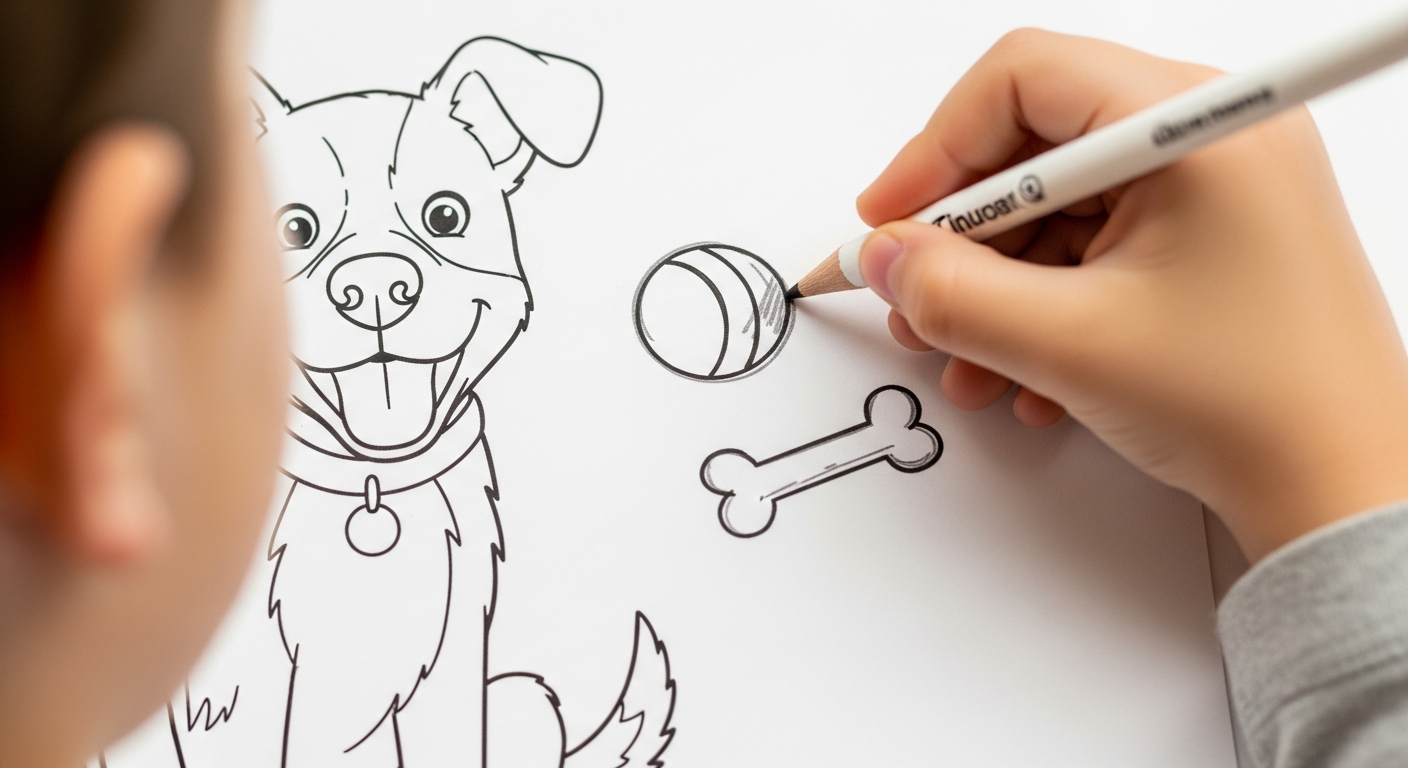
A child drawing a ball next to a dog coloring page to finish the story.
Engage the child’s critical thinking before they pick up a pencil. Use open-ended questions to spark visual problem solving.
- Question: “This dog looks like he is waiting for something. What do you think he wants?”
- Answer: “A bone!” or “A ball!”
- Action: “Perfect! Can you draw a round ball right here near his paws?”
- Psychological Impact: The child is no longer “drawing a picture”; they are “solving a problem.” The focus shifts from the aesthetic quality of the drawing to its narrative function. A lopsided circle is perfectly acceptable because it successfully solves the narrative problem of the dog needing a toy.
Technique B: Symmetry Completion
Use coloring pages that are symmetrical (like a butterfly or a face) and fold them in half, or find pages designed with only half the image.
- The Challenge: “Can you help the butterfly fly? It needs its other wing.”
- Educational Value: This scaffolds spatial awareness and geometry. The child has a direct reference model (the printed half) right next to their drawing space, making it easier to copy lines and shapes than if they were drawing from memory.
Tools of the Trade: Mediums that Matter
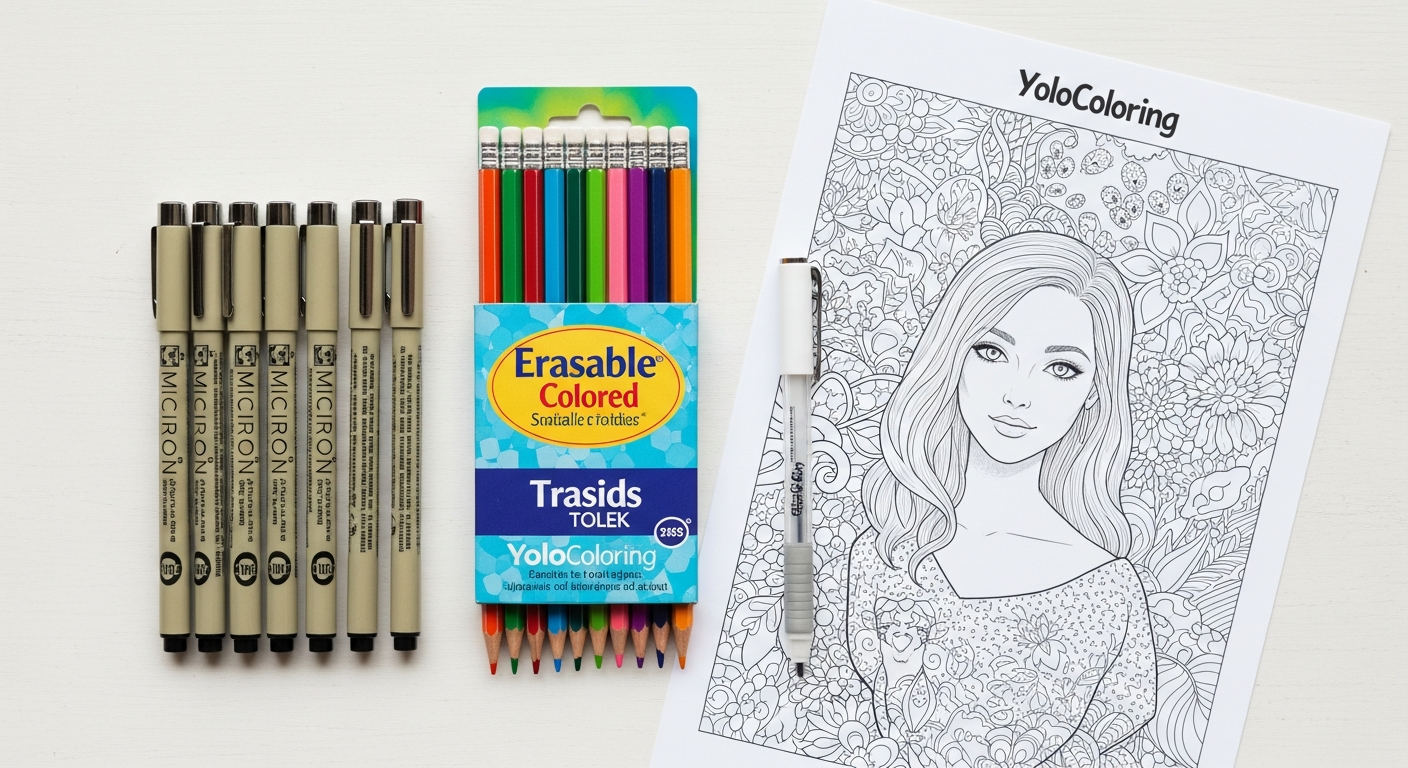
Flat lay of fine-tip markers, erasable colored pencils, and white gel pens on a desk.
The tool a child holds can dictate their confidence level. A blunt, waxy crayon offers little control for detailed doodling, which can reinforce the feeling of “I can’t draw.” To encourage doodling in the margins, we must upgrade the toolkit.
1. Fine-Tip Black Markers (The “Pro” Tool)
Give a child a black fine-liner (felt tip pen) to add doodles before they color.
- Why: The coloring page is printed in black ink. When the child draws in black ink, their additions look like part of the original book. This visual integration is incredibly satisfying and boosts ownership of the artwork.
- Recommendation: Use washable fine-tip markers for younger kids, and permanent fine-liners (like Micron or Sharpie) for older kids who want to watercolor over their lines.
2. Erasable Colored Pencils
Perfectionism is the enemy of creativity. The fear of making a permanent mistake paralyzes the hand.
- Why: Erasable colored pencils provide a psychological safety net. Knowing they can “undo” a doodle allows them to take risks they would otherwise avoid.
- Technique: Encourage sketching the background elements lightly in erasable blue pencil first (like real animators do!) before committing to darker lines.
3. White Gel Pens
The secret weapon for “fixing” and “enhancing.”
- Application: After coloring an area solid (like a black cat), use a white gel pen to draw whiskers or eye reflections on top.
- Impact: This adds immediate depth and realism (“the sparkle in the eye”) with zero drawing skill required. It teaches the concept of highlights and layering.
| Tool | Best For | Confidence Factor |
| Crayons | Texture rubbings, broad filling | Low precision, high comfort |
| Fine-Liner Pens | Doodling outlines, matching the printed page | High precision, “Pro” feel |
| Colored Pencils | Shading, fur texture, gradients | High control, layerable |
| White Gel Pen | Highlights, fixing mistakes, stars | “Magic” factor, high reward |
Age-Appropriate Scaffolding Strategies
The approach must evolve as the child develops. A toddler needs motor skill support; a tween needs intellectual engagement.
Toddlers and Preschoolers (Ages 3-5): The Scribble Stage
At this age, “I can’t draw” usually means “I can’t control my hand.” The goal is motor development.
Activity: Rain and Grass.
- Use a coloring page of a flower. Ask the child to make it “rain” by drawing vertical lines from the top of the page down to the flower.
- Skill: Vertical strokes, downward force.
Activity: The Cage.
- Use a coloring page of a lion. Ask the child to “keep the lion safe” by drawing bars (vertical and horizontal lines) over the picture.
- Skill: Crossing the midline, intersection.
Early Elementary (Ages 6-8): The Narrative Stage
These children are storytellers. They want their art to communicate action.
Activity: Comic Strip Expansion.
- Use a coloring page with a character. Draw a “speech bubble” or “thought bubble” for the child and ask them to draw (or write) what the character is saying.
- Skill: Integrating text and image, narrative logic.
Activity: The Weather God.
- Ask the child to decide the weather. If they draw a sun, they color the scene bright. If they draw clouds, they color it grey. This teaches cause-and-effect in artistic composition.
Tweens and Pre-Teens (Ages 9-12): The Realism Stage
This is the “crisis” demographic. They value aesthetics and realism. Strategies must focus on techniques that make the image look “cool” or “3D.”
Activity: The Gradient Background.
- Instead of drawing objects, teach them to color the background in a smooth gradient (e.g., dark blue at top fading to light blue).
- Why: It requires no drawing “skill” (just coloring pressure control) but produces a sophisticated, professional look that satisfies their desire for realism.
Activity: Zentangle Backgrounds.
- Use a ruler to divide the background into geometric sections. Fill each section with a different abstract pattern (checkerboard, spirals).
- Why: It shifts the focus from “drawing a realistic tree” to “designing a cool pattern,” bypassing the realism critic entirely.
Overcoming the “Inner Critic”: A Guide for Parents
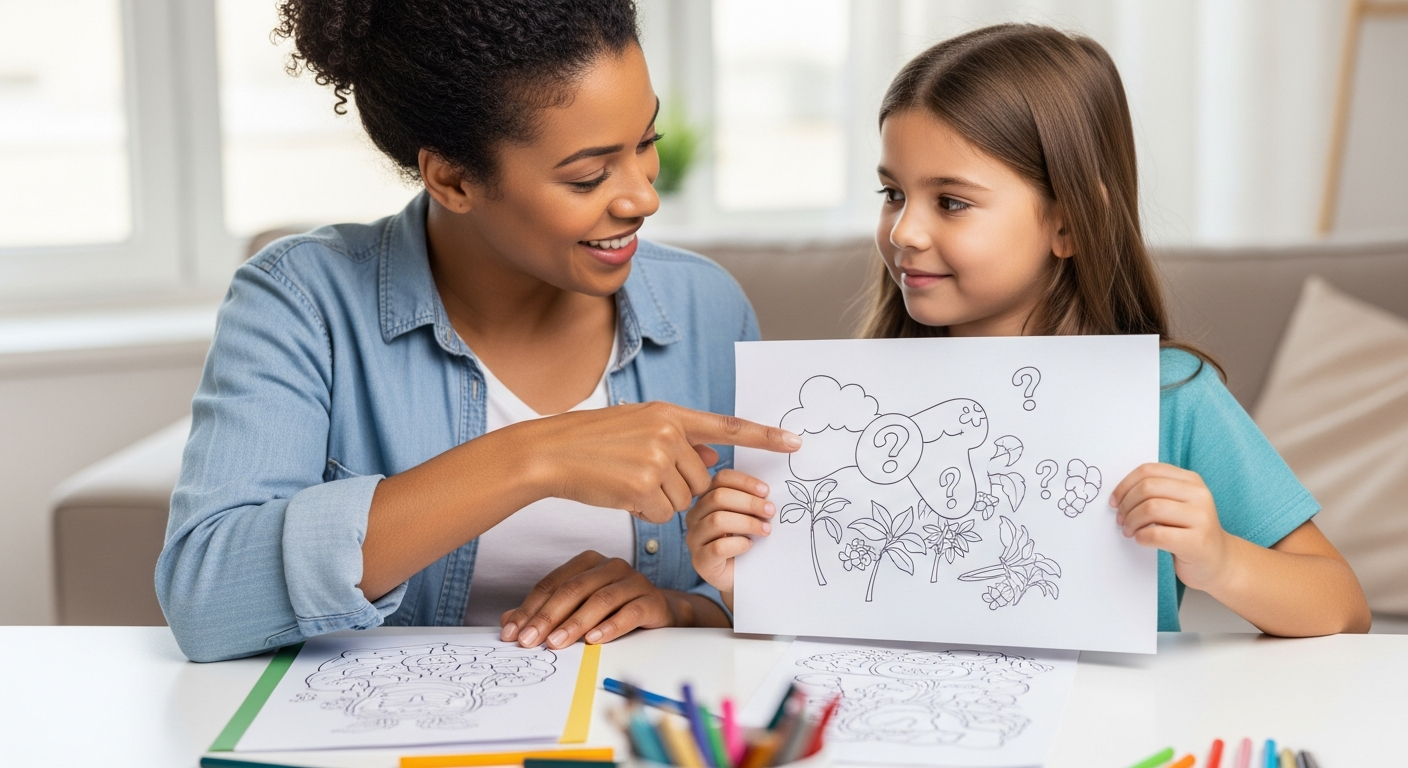
A parent and child coloring together and discussing the artwork.
The way parents respond to a child’s art can reinforce or dismantle the “I can’t draw” narrative. Research suggests that praise focused on talent (“You’re such a good artist”) is less effective than praise focused on effort and process (“I love how hard you worked on those textures”).
The “Beautiful Oops” Philosophy
When a child makes a “mistake” – a line goes outside the box, or a shape is wobbly – they may want to tear up the paper. Intervene with the “Beautiful Oops” mindset (inspired by Barney Saltzberg’s book).
- Script: “Oh, look at that stray line! It looks just like a worm. Let’s add two eyes to it. Now it’s a worm watching the picture!”
- Lesson: Art is flexible. Mistakes are just unexpected starting points. This resilience is crucial for creativity.
Strategic Questioning
Instead of saying “Good job,” ask questions that force the child to reflect on their choices. This builds their internal validation system.
- “What is your favorite part of this picture?”
- “How did you decide to use green for the sky? That’s really interesting.”
- “What would happen if we added a tree right here?”.
Modeling Imperfection
Children need to see adults struggle and succeed. Sit down with your own YoloColoring sheet.
- Action: Intentionally draw a “bad” tree.
- Say: “Hmm, this tree looks a bit lopsided. That’s okay, maybe the wind is blowing it! I’m going to keep coloring it anyway.”
- Impact: This models that art doesn’t have to be perfect to be enjoyable. It gives them permission to be imperfect too.
Advanced Classroom Applications: Coloring as Art Education
Teachers can use coloring pages to teach rigorous art concepts without the time commitment of a full studio project. This is “stealth education.”
Teaching Perspective through Coloring
- Lesson: Use a coloring page of a street or a path.
- Task: Ask students to draw trees along the path. Instruct them to make the trees smaller as the path goes further away.
- Concept: This introduces diminution and linear perspective within a safe, pre-structured environment.
Teaching Light and Shadow (Chiaroscuro)
- Lesson: Use a coloring page of a simple sphere or fruit.
- Task: Identify a “light source” (draw a sun in the corner). Ask students to color the object lighter on the side facing the sun and darker on the side facing away.
- Concept: Understanding value and form (making 2D look 3D).
Teaching Color Theory
- Lesson: Use a complex mandala coloring page.
- Task: Restrict the palette. “Color this using only complementary colors (opposites on the wheel, like blue and orange).”
- Concept: Understanding color relationships and harmony.
Creative Prompts Library: 50 Ideas to Fill the Void
Stuck on what to suggest? Here is a curated list of prompts designed to trigger specific drawing actions in the empty spaces of coloring pages.
For Animal Pages
- The Menu: Draw what this animal is eating for lunch.
- The Home: Draw the cave, nest, or bed where this animal sleeps.
- The Friend: Draw a tiny bug or bird that is friends with this animal.
- The Weather: Draw rain, snow, or wind lines around the animal.
- The Dream: Draw a thought bubble showing what the animal is dreaming about.
- The Costume: Draw a hat or a bow tie on the animal.
- The Tracks: Draw footprints leading up to the animal.
- The Hiding Spot: Draw tall grass or a bush covering part of the animal.
- The Toy: Draw a ball or yarn for the animal to play with.
- The Noise: Draw “sound lines” (zig-zags) coming from the animal’s mouth.
For Character/People Pages
- The Floor: Is the floor checkered? Wood? Grass? Draw the texture.
- The Window: Draw a window on the wall. What is outside?
- The Pet: Draw a pet walking next to the character.
- The Shadow: Draw the character’s shadow on the ground.
- The Bag: Draw a backpack or purse. What is spilling out of it?
- The Hobby: Draw a book, a guitar, or a soccer ball in their hand.
- The Furniture: Draw a chair or a table behind them.
- The Wall Art: Draw a picture frame on the wall behind them. What is in the picture?
- The Carpet: Draw a patterned rug under their feet.
- The Light Source: Draw a lamp or the sun. Show the light rays.
For Vehicle Pages
- The Road: Is the road bumpy? Curvy? Draw the lines.
- The Sign: Draw a street sign. What does it say?
- The Cargo: Draw what is in the back of the truck.
- The Destination: Draw a house or a castle in the distance.
- The Obstacle: Draw a puddle or a rock in the road.
- The Driver: Draw who is driving (an alien? a cat?).
- The Speed: Draw speed lines and dust clouds behind the tires.
- The Sky: Draw a plane or birds flying above the car.
- The Garage: Draw tools hanging on the wall behind the car.
- The Map: Draw a map sitting on the dashboard.
Abstract/Pattern Prompts (For Backgrounds)
- Polka Dots: Fill the background with varying sizes of circles.
- Stripes: Draw diagonal lines across the entire background.
- Swirls: Fill the space with loopy “wind” lines.
- Stars: Draw tiny stars and moons.
- Hearts: Fill the background with floating hearts.
- Bricks: Draw a brick wall pattern behind the subject.
- Confetti: Draw tiny squares and triangles falling down.
- Bubbles: Draw overlapping circles of different sizes.
- Checkerboard: Create a grid and color every other square.
- Zig-Zags: Fill the background with electric zig-zag lines.
“Finish the Story” Prompts
- The Surprise: Draw a box. What is popping out of it?
- The Magic: Draw magic sparkles coming from the object.
- The Water: Draw waves. Is the character surfing? Swimming?
- The Forest: Draw tree trunks behind the subject.
- The City: Draw square buildings with windows in the background.
- The Audience: Draw heads of people watching the character.
- The Balloon: Draw a balloon string in their hand. Where is the balloon going?
- The Mess: Draw a spilled drink or a mud puddle.
- The Collection: Draw 5 more of the same object (e.g., if there is one flower, draw 5 more). This is a creative way to teach numbers and counting while drawing.
- The Contrast: If the picture is cute, draw something spooky in the background (or vice versa).
Integrating Digital Tools
In the modern age, we cannot ignore digital art. Tablets can be an excellent low-stakes way to practice “doodling in the gaps.”
The “Undo” Button Safety Net
Apps like Procreate or even simple coloring apps allow children to draw on top of a coloring page layer.
- Benefit: The “Undo” button is the ultimate anxiety reducer. Knowing they can instantly vanish a mistake encourages wild experimentation that paper might not.
- Activity: Take a photo of a printed coloring page. Import it into a drawing app. Let the child draw backgrounds digitally using “glow” brushes or “pattern” stamps. This hybrid approach bridges traditional skills with modern tech.
AI as a Collaborator
Tools like “sketch-to-image” AI can turn a child’s rough background doodle into a polished image.
- Activity: Have the child draw a rough “tree” in the background of a coloring page. Use an AI tool to “render” it.
- Impact: This shows the child the potential of their idea, validating their composition choices even if their motor skills are developing.
The Bridge to Artistic Independence
The journey from “I can’t draw” to “Look what I made” is paved with small victories. Printable coloring sheets provide the steady ground upon which these victories are won. By using the coloring page not as a boundary, but as a foundation, we give children the license to create without fear.
When a child adds a horizon line, they are learning perspective. When they rub a crayon over a leaf to make a background, they are learning texture. When they draw a speech bubble, they are learning narrative. These are not “just doodles”; they are the building blocks of artistic literacy.
At YoloColoring, we are committed to providing the high-quality, open-ended resources that make this journey possible. Our pages are designed with intentional spaces – invitations for the imagination to enter. We invite you to print a page, hand your child a fine-point marker, and ask the magic question: “What do you think belongs in this empty space?”
The answer might just be the beginning of a lifelong love of art.
Frequently Asked Questions
Q1: My child refuses to draw anything and only wants to color. Should I force them to doodle?
Answer: No. Forcing creativity creates resistance. Start by modeling the behavior. Sit next to them with your own coloring page and say, “I think I’ll draw a cloud here.” Watch them observe. Often, curiosity will lead them to copy you. Validating their coloring as is builds the trust needed to try new things later.
Q2: What should I do if my child draws something and then cries because it “ruined” the coloring page?
Answer: Validate their feelings (“It is frustrating when it doesn’t look like you imagined”). Then, offer a solution: “Let’s turn this ‘mistake’ into something else.” A wobbly line can become a snake or a vine. Alternatively, keep a “test sheet” of scrap paper nearby where they can practice the doodle before committing it to the main coloring page.
Q3: Are there specific coloring pages that are better for doodling?
Answer: Yes. Look for pages with “simple outlines” rather than “complex mandalas.” Pages with a single central character and a blank background are ideal. At YoloColoring, look for our “Scene Starters” category, which is specifically designed with large negative spaces to encourage background drawing.
Q4: My child says they have no ideas. How can I help?
Answer: Use the “Choice Strategy.” Instead of saying “Draw whatever you want” (which is overwhelming), give two choices: “Should we draw a sun or a moon?” or “Does this dog need a bone or a ball?” Narrowing the options reduces anxiety and jumpstarts the decision-making process.
Q5: Can this method help with handwriting?
Answer: Yes! Doodling small patterns (like scales, fur, or grass) requires the same fine motor muscles and “tripod grip” used for holding a pencil to write. It is an excellent, low-pressure way to build hand strength and dexterity without the academic pressure of handwriting practice.

Sophia Williams is the voice of the YoloColoring community. As our Content Editor, she crafts all the helpful articles, guides, and descriptions you read on the site. She is also our Community Manager, dedicated to connecting with users, celebrating their creations, and fostering a warm, supportive environment for all colorists.